Start with what you are actually buying
You are not buying a battery. You are buying a defined number of hours in which your business continues to operate when the grid fails. In Uganda, the grid does fail: UEDCL's 2026 parliamentary testimony puts the average customer at 64 hours of outages per year and 46 interruptions, against a 34-hour regulatory limit. A sizing decision based on '10 kWh should be fine' is exactly how businesses end up with a backup system that dies before the outage ends.
The calculation method
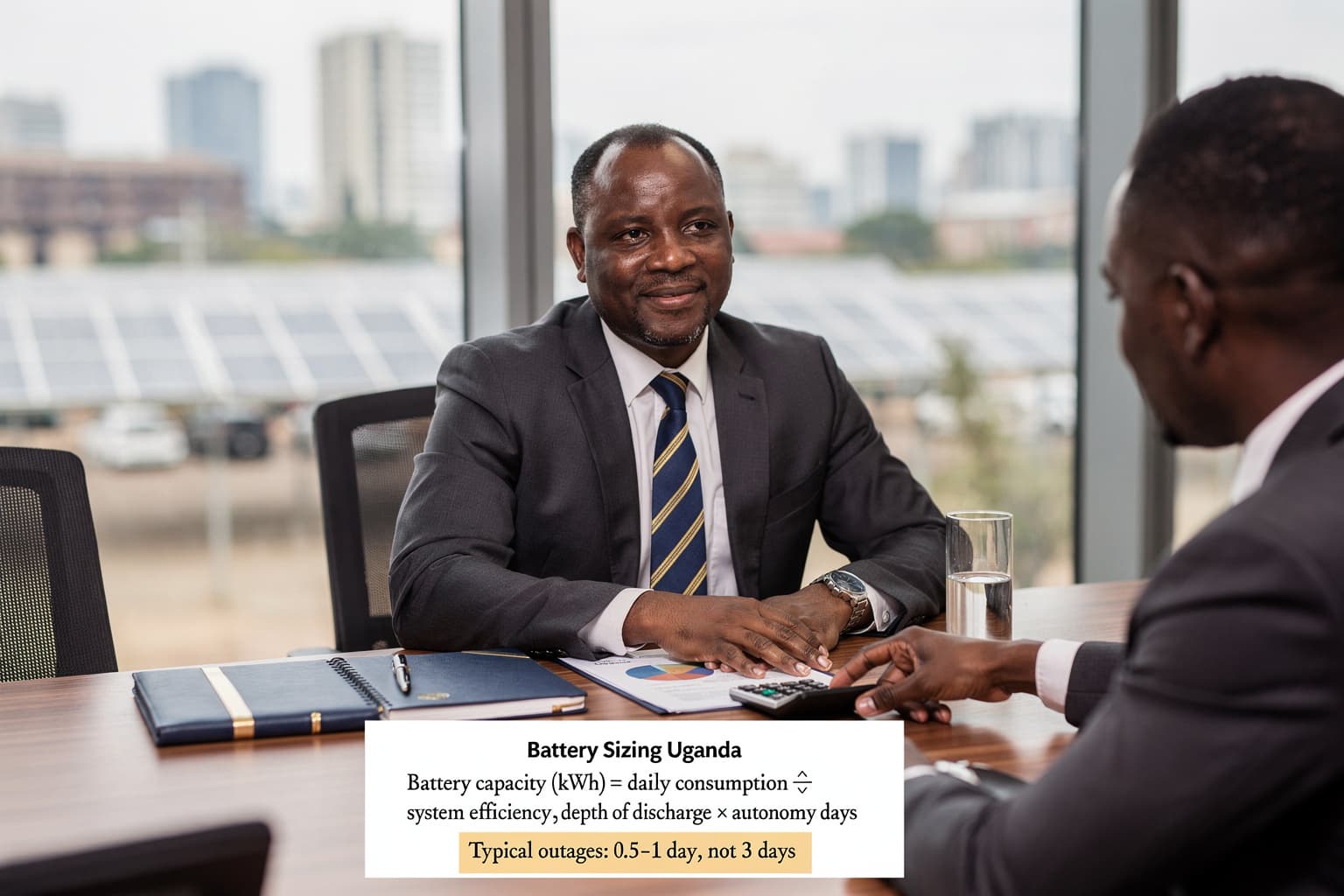
The industry-standard sizing formula is: Battery Capacity (kWh) = (Daily Energy Consumption ÷ System Efficiency) ÷ Depth of Discharge. In plain English: take the energy you consume in a day, divide by how much of the energy actually reaches your load, then divide by how much of the battery you can safely use before recharging. For a lithium iron phosphate (LiFePO4) battery, depth of discharge is typically 80–90% and system efficiency is around 90%.
- Daily Energy Consumption: the kWh your equipment draws in 24 hours.
- System Efficiency: the losses in inverter and wiring, usually around 10%.
- Depth of Discharge: the portion of battery capacity you can use without damaging the battery.
Step 1: Estimate daily energy consumption realistically
List every device that must run during an outage — fridges, lights, computers, security, water pumps, the network cabinet — and multiply watts by hours per day. Do not use total connected load unless everything runs at once. Many businesses over-provision by summing nameplate ratings instead of measured duty cycles; that creates large battery cost for no additional resilience.
Step 2: Apply system efficiency
A well-designed inverter and cabling system is about 90% efficient, meaning roughly one kWh in ten is lost between the battery and your equipment. If your true daily consumption is 10 kWh, you need about 11.1 kWh of stored energy before considering depth of discharge. This detail is frequently omitted from rough quotes, and it quietly changes the number.
Step 3: Choose depth of discharge for LiFePO4
What depth of discharge means
For lead-acid batteries, deep discharge shortens life sharply. LiFePO4 is designed for 80–90% depth of discharge, so a 10 kWh LiFePO4 battery delivers 8–9 kWh of usable energy. That is why LiFePO4 has become common for commercial backup in Uganda.
Step 4: Decide autonomy days — and question the default of three
Autonomy days are how many days the battery must cover your load without any grid or solar recharging. Many installers default to two or three days. For most Ugandan firms, that is an expensive answer to a problem the data does not support. UEDCL's 2026 testimony shows average restoration time is now 20 hours, up from 12 under Umeme. The Uganda Manufacturers Association reports 4–7 outages per week, but most are short; 2024 research found equipment failures are typically resolved in about six hours and vandalism in about fourteen hours.
Three-day autonomy only becomes rational if your site is isolated, public grid restoration is unusually slow, or you cannot tolerate a single interruption. Otherwise, it is pre-paying for outages that may never arrive.
Sizing checkpoint
For a business with stable daily load and at least some daytime solar generation, start with half a day to one full day of autonomy. You can usually add a second battery module later if real outage data proves you need it.
Worked example: a 10 kWh/day business
Using the formula: (10 kWh ÷ 0.9) ÷ 0.8 ≈ 13.9 kWh. That is the usable battery capacity for one day of consumption. For half a day of autonomy, you would need roughly 7 kWh; for one full day, around 14 kWh. In market terms, a 48V 200Ah LiFePO4 battery stores about 9.6 kWh, so this business would need roughly two of those modules for a little over one full day's backup.
The Ugandan context changes the math
Outage frequency is the bigger problem than duration. UEDCL data for May 2025–March 2026 recorded 4,486.59 hours of distribution outages and 20.75 GWh of lost energy. Some firms report 15 interruptions in a single day. Frequent, short interruptions favor a smaller battery that recharges quickly from solar, not a large battery sized for a rare multi-day blackout.
64 hours
Average customer outage duration per year (UEDCL 2026 testimony)
What over-sizing and under-sizing cost you
Under-sizing means the battery reaches its cut-off before the grid returns. The cost is not just halted production; it is the cost of repeatedly deep cycling a small battery, then replacing it early. Over-sizing means capital is trapped in a battery bank that only earns its return during an outage — capital that could have gone into more PV capacity, a better inverter, or working capital.
Under-sizing: the hidden replacement cost
If a 9.6 kWh LiFePO4 module is cycled to 90% depth of discharge daily because it is too small, its cycle life shortens. It may be cheaper to buy a slightly larger bank from the start than to replace a small battery prematurely.
Over-sizing: the silent drag
A battery's value is realized only when the grid fails. At Uganda's commercial tariff of 546.4 UGX per kWh, every unused kWh of stored energy is inventory that does not produce. Oversized batteries also require more space, more cooling, and a larger charge controller and inverter.
Battery sizing is the beginning, not the end
Once you have a defensible kWh target, the next question is total cost of ownership. It is worth understanding how zero-upfront solar structures affect your battery decision, because financing can change whether a larger battery is a capital burden or a cash-flow problem.
If you are considering a commercial system above the small-scale threshold, Uganda's 200 MW solar ceiling can determine whether you can export surplus power or must size strictly for self-consumption.
The honest bottom line
There is no single correct battery size for every Ugandan business. The number depends on your measured daily load, your tolerance for interruptions, and whether you have daytime solar generation. But the method is not optional. Apply the formula, question three-day autonomy defaults, and test the cost of under-sizing and over-sizing before you sign. If the assumptions are defensible, the decision becomes much easier to defend.